
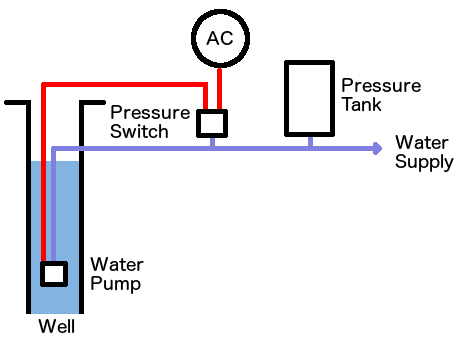

If your Central Florida well pump cycles on every 30 seconds, the problem is almost always your pressure tank, not the pump itself. The internal bladder has lost its air pre-charge, reducing drawdown from 20+ gallons to nearly zero. Ignoring it kills your pump within a year. Here is how to diagnose and fix it.
Short-cycling is the single most common pump-system complaint we see across Marion, Alachua, Citrus, Lake, Orange, Seminole, Volusia, and Polk counties. The homeowner hears the pump click on, run for a few seconds, click off, and then click back on again the moment someone flushes a toilet or runs a kitchen faucet. The pump sounds healthy, the water flows, and nothing seems obviously broken. Yet inside that pressure tank, a slow mechanical failure is destroying the pump motor one start cycle at a time.
Quality Filters And Pumps has serviced wells across Central Florida for 15+ years. Chase Norris holds FL Water Well Contractor License #7494. The diagnostic sequence below is what our crew runs on every short-cycle call, and most of it you can do yourself in under 10 minutes with a tire gauge and a wrench.
Pump clicking on every 30 seconds?
Every short-cycle start burns out the motor faster. Don't wait for the pump to die. Call (352) 268-9048 or request a pressure-tank diagnosis. Same-day visits across Ocala, Gainesville, Orlando, and the rest of Central Florida.
How a Pressure Tank Actually Works
A residential well pressure tank is a steel vessel with a flexible rubber bladder or diaphragm inside. The bladder separates the tank into two chambers. The top side is sealed and pre-charged with compressed air. The bottom side is plumbed to the well system and fills with water when the pump runs.
When the pump turns on, it pushes water into the tank, compressing the air on the other side of the bladder. The air pressure builds until it hits the cut-out point on your pressure switch, usually 50 or 60 psi. The pump shuts off. When you open a faucet, the compressed air pushes water back out of the tank, maintaining steady pressure at the fixtures. As the tank empties, pressure drops. When it hits the cut-in point (typically 30 or 40 psi), the pump kicks back on and the cycle repeats.
The amount of water the tank can deliver between cut-in and cut-out is called drawdown. A healthy 30 gallon tank with a 30/50 switch and a correct 28 psi air pre-charge delivers roughly 8 to 12 gallons of drawdown per cycle. A healthy 80 gallon tank delivers 20 to 30 gallons. That drawdown is what lets you run a shower, flush a toilet, or fill a pot without the pump kicking on every time you turn the tap.
When the bladder fails or the air pre-charge bleeds off, drawdown collapses to 1 or 2 gallons. The pump cycles constantly because the tank can no longer buffer flow. That is short-cycling, and it is mechanically destructive in ways most homeowners do not realize until the pump itself fails.
The 4 Pressure Tank Failure Modes
Pressure tanks fail in four distinct ways. Diagnosing which mode you have changes the fix, so it is worth understanding all four before you reach for a wrench.
Bladder rupture. The rubber bladder tears or splits. Water mixes with the air side, the tank fills with water, and drawdown drops to almost nothing. This is the most common failure on tanks over 7 years old in Central Florida. The bladder fatigues from temperature cycling and millions of compression cycles.
Lost air pre-charge. The bladder is intact, but the Schrader valve on top of the tank has leaked off the air cushion over time. The tank is fine mechanically, but it behaves like a torn-bladder tank because there is no air pressure doing the work. Cheapest fix on the list, recharge with a bike pump or compressor.
Waterlogged tank. The term applies broadly to any tank where the air-to-water ratio is wrong. Older bladderless or galvanized tanks waterlog naturally as air dissolves into the water. Modern bladder tanks waterlog only when the bladder fails. Either way: too much water, not enough air, no drawdown.
Sediment or scale damage. Central Florida well water is hard. Calcium and iron deposits collect on the bladder, embrittling the rubber and jamming it against the tank wall. In iron-heavy surficial-aquifer water, the bladder can also rust where it meets the steel shell. See our iron and sulfur guide for what high-mineral water does to system components.
The 5-Minute Diagnosis You Can Do Yourself
Before you call anyone, run this two-step test. It takes about five minutes and rules in or out a tank problem before you spend money on a service call.
Step 1: The tap test. With the pump on and the tank at normal operating pressure, knock on the side of the tank with your knuckles. Start at the top and work down toward the base. A healthy tank with a proper air charge sounds hollow at the top (compressed air) and dull or solid at the bottom (water). You should hear a clear difference, with the transition between the two sounds roughly in the middle of the tank.
If the entire tank sounds the same from top to bottom, dull and solid all the way up, the tank is full of water and the bladder is failed or the air pre-charge is gone. If the entire tank sounds hollow, you have a different problem entirely (extremely low water in the system, or a tank not getting water flow at all, which usually points to an upstream valve or a check valve failure).
Step 2: The cycle-count test. Open a single faucet, like a bathroom sink, on cold water at a low to moderate flow rate. Count how often the pump kicks on while the water is running. A healthy system should run the pump exactly once and then let the tank deliver the rest of the water until you close the tap, or run the pump continuously if your flow rate exceeds the pump's output (which is rare on a single faucet).
A tank in trouble will cycle the pump every 30 to 60 seconds during a single-faucet flow. That rapid cycling, with the pump running just long enough to bring the gauge up to cut-out and then immediately needing to restart, is the signature of collapsed drawdown.
If both tests point to the tank, move to the air-pressure check below.
The Air Pressure Check
This is the test that confirms a bladder problem and separates "the tank is dead" from "the tank just needs an air recharge." You need a tire pressure gauge and access to the Schrader valve on top of the tank.
First, kill power to the pump at the breaker. Then open a faucet downstream of the tank and drain the system until water stops flowing and the pressure gauge reads zero. This is critical: you cannot accurately test the air pre-charge while there is water pressure inside the tank pushing back against the bladder.
Now find the Schrader valve on top of the tank. It looks exactly like the valve stem on a car or bicycle tire. Pull the rubber cap, press your tire gauge onto the valve, and read the pressure.
The correct pre-charge is 2 psi below your pressure switch cut-in. For a 30/50 switch (the most common in Central Florida residential installs), the pre-charge should read 28 psi. For a 40/60 switch, the pre-charge should read 38 psi. If the gauge reads close to the target, the bladder is intact and the cushion is correct. The short-cycling is being caused by something else (often a leaking pressure switch, a stuck pressure-relief valve, or a foot-valve leak). If the gauge reads zero or near zero, you have either a lost air charge or a failed bladder.
To tell the difference: with the system still drained and the gauge attached, pump air into the Schrader valve. Add air slowly. If the pressure builds normally and holds at your target without water coming out of the open faucet downstream, the bladder is intact and you just needed a recharge. Close everything up, restore power, and watch the system over the next week. If air pushes water out of the open downstream faucet, or if the pressure refuses to build, the bladder is torn and the tank needs to be replaced. See our pressure tank sizing guide for the replacement specs you'll want to match.
Why Florida Pressure Tanks Fail Faster
Manufacturers (Amtrol Well-X-Trol, Goulds, Flexcon) rate residential tanks for 7 to 12 years. In Central Florida, tanks fall toward the lower end of that range. Three factors drive the difference.
Lightning strikes. Central Florida has the highest lightning density in the United States. Lightning damages tanks indirectly: a nearby surge welds the pressure switch closed or burns out the start capacitor, the pump cycles abnormally, and the bladder fatigues weeks later. Surge protection at the panel reduces this risk. Our lightning damage guide covers protection in detail.
High water tables and sandy soils. Florida's surficial aquifer pulls water higher in dissolved iron, organics, and bacteria than the deeper Floridan. These constituents collect on the bladder, accelerating rubber breakdown and corroding the bladder-to-tank seal. Surficial tanks fail faster than Floridan tanks.
Hard-water scale. Floridan water across most of Marion, Alachua, Orange, and surrounding counties runs 15 to 40+ grains per gallon hardness. Calcium deposits on the bladder cause loss of flexibility and premature cracking. Softened water (or a sediment pre-filter ahead of the tank) extends bladder life noticeably.
Realistic Central Florida pressure tank lifespan: 7 to 10 years. Past 10 years, expect failures. Plan replacement before the bladder takes out your pump.
The Fix: Pressure Tank Replacement, Not Pump Replacement
Once the bladder is torn, the tank cannot be repaired. Bladder-replacement kits exist for industrial tanks, but no manufacturer makes a field-replaceable bladder for a residential pressure tank. The fix is a new tank.
What we tell every short-cycle customer: replacing the tank now saves the pump later. A submersible pump draws several times its normal current at startup. A pump that should start 20 times a day instead starts 200 to 500 times a day during short-cycling. Motor windings overheat, the start capacitor wears out, and the pump body can fail within a year. By the time the pump quits, you are buying a new tank plus a new pump plus a pump pull.
When sizing the replacement, match or exceed the original drawdown. The standard rule is one minute of pump run-time per cycle minimum. For a typical 10 gpm submersible, that means 10 gallons of drawdown, which sizes to roughly an 80 gallon nominal tank (most "80 gallon" tanks deliver 22 to 26 gallons of actual drawdown). Smaller pumps in shallower wells can use 30 to 44 gallon tanks. Our tank sizing guide walks the math.
If you are doing the work yourself, the job involves shutting off the well, draining the tank, disconnecting the tank tee and union, lifting the old tank out (a waterlogged 80 gallon tank can weigh 700 pounds), setting the new tank, reconnecting plumbing, pre-charging to 2 psi below cut-in, and restarting. Most homeowners hire this out because the lifting is awkward and a cross-thread leak shows up immediately.
Ready for a tank replacement?
We carry Amtrol, Goulds, and Flexcon tanks in stock at the truck, with same-day installation across Leesburg, Kissimmee, Sanford, and 19 other Central Florida cities. Call (352) 268-9048 or request a quote. Financing available for tank and pump packages.
Recommended Method: Symptom to Action
| What you observe | Most likely cause | Next action |
|---|---|---|
| Pump cycles every 30 to 60 seconds during a single open faucet | Failed bladder or lost air charge | Run the air pressure check below |
| Tank sounds dull and solid from top to bottom on the tap test | Bladder torn, tank full of water | Replace the tank |
| Air pre-charge reads zero, recharging holds normally | Lost air through Schrader valve over time | Recharge to 2 psi below cut-in, monitor weekly |
| Air pre-charge reads zero, will not hold when recharged | Bladder failure | Replace the tank |
| Tank tests fine but pump still short-cycles | Leaking pressure switch, stuck relief valve, or foot-valve leak | Check switch contacts, relief valve drip, and drop-pipe pressure |
| Tank is over 10 years old, no symptoms yet | End-of-life approaching | Plan proactive replacement before the pump pays the price |
| Short-cycling started after a thunderstorm | Lightning damaged the switch, which then fatigued the bladder | Replace the switch and inspect the tank pre-charge |
If the table sends you toward replacement and you'd rather not run that work yourself, our pump repair service handles tank and pump diagnostics across the full Central Florida service area. For broader pump troubleshooting beyond short-cycling, see the pump troubleshooting pillar guide.
Call a Professional If
Run the diagnostic steps above first. Most short-cycle problems are findable in 10 minutes with a tire gauge. Bring in a licensed contractor if any of the following apply.
- The tank is over 7 years old and you are not comfortable lifting and reseating an 80 gallon tank in a tight equipment area.
- The air pre-charge holds when you pump it up, but the pump still short-cycles. That points to a leak elsewhere (pressure switch, foot valve, drop-pipe coupling) that needs a contractor's pressure test.
- Resetting the breaker after a thunderstorm trips it again immediately. Lightning often damages pump, switch, and tank together.
- Water hammering, banging pipes, or pulsing flow that gets worse over time. That can mask a tank problem behind a separate plumbing issue.
- You smell burned plastic at the pressure switch or control box. Replace the switch first, then re-check the tank under load.
- The well is over 200 feet deep. Deep Floridan wells need a hoist and a crew for any pump-side work. See our karst country drilling guide.
Florida well work below the casing is regulated under FAC Chapter 62-532. Above-ground tank work is unlicensed, but matching the switch settings, air pre-charge, and tank capacity to your pump's flow rate is where most DIY replacements go wrong. For related diagnostics, see pumps that won't turn on, pumps that won't shut off, repair vs replace decisions, and the sand and sediment guide.
Get the tank fixed before the pump fails
Short-cycling is a problem you can let slide for a few weeks, not six months. If the diagnostic above points to a tank problem, get it fixed before the pump joins the failure list. Call (352) 268-9048 or request a service visit. Quality Filters And Pumps has serviced Central Florida wells for 15+ years, led by Chase Norris (FL Water Well Contractor License #7494). Service areas include Orlando, Kissimmee, Ocala, Gainesville, and 18 other cities. See also our well drilling and water filtration services, and the 15 years of patterns retrospective. Background on the about page. Financing available.