
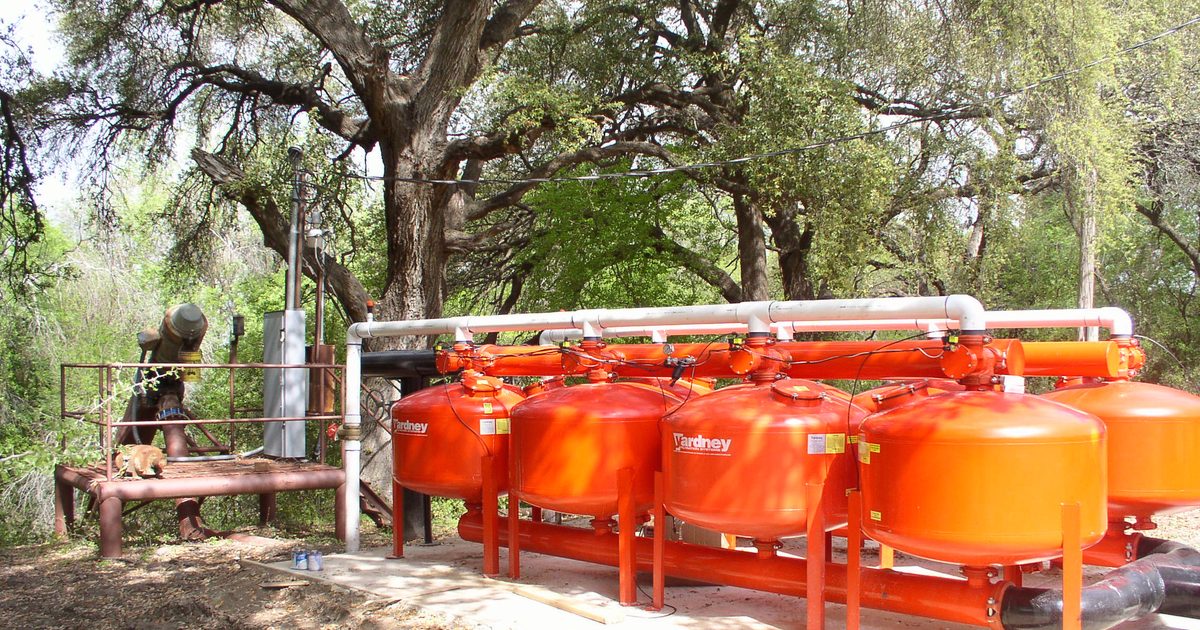

A whole-house iron filter installation in a Central Florida home takes 4 to 7 hours on a single visit, including the plumbing tie-in at the well pressure tank, a 120V electrical connection, and a backwash drain to a code-approved discharge point. Expect a brief water shutoff of 30 to 90 minutes during cut-in and a 24-hour break-in cycle before treated water reaches every tap. The day-of sequence and prep below remove the most common surprises homeowners hit on install morning.
Most installation problems are not the equipment; they are the prep. A tank that lands in the wrong spot, a drain line that does not meet local plumbing code, or an electrical outlet that has no nearby receptacle adds hours and sometimes a callback. This guide walks the day-of install sequence for the four most common iron-filter types we install across Marion, Alachua, Citrus, Lake, Orange, Seminole, Volusia, and Polk counties, plus the prep checklist that keeps install day on schedule.
Quality Filters And Pumps has installed thousands of whole-house filtration systems across Central Florida over 15+ years. Chase Norris holds FL Water Well Contractor License #7494. The day-of sequence below is the one we actually run.
The Four Iron-Filter Types We Install in Central Florida
Not every iron problem needs the same filter. The first decision on install day is matching the equipment to the raw-water chemistry, and that decision should have happened before the truck rolls. The four common configurations across our service area:
Air-injection oxidizing filter (AIO). Our most-installed unit for 0.5 to 7 ppm iron and modest hydrogen sulfide. A single tank with an internal air pocket oxidizes iron and sulfide on the way in, then traps the precipitate in a media bed (typically Katalox Light or Greensand Plus). Self-cleans on a daily or every-other-day backwash. Equipment cost $1,800 to $3,200; installed $2,400 to $4,200.
Chlorine injection plus contact tank plus carbon filter. Heavy-iron and bacterial-iron wells (over 5 ppm, slimy biofilm, sulfur). A peristaltic pump injects a metered chlorine solution into the water line, then a contact tank gives 5+ minutes of reaction time, then a carbon filter polishes out the chlorine residual. Equipment cost $2,800 to $4,800; installed $3,600 to $6,200.
Manganese greensand filter. Used where iron is present alongside manganese over 0.05 ppm (the "black-staining cousin" of iron). Operates on a potassium permanganate regeneration cycle. Equipment cost $2,000 to $3,400; installed $2,800 to $4,600.
Aeration system plus filter. Open-tank aeration is rare in residential Florida (because of the footprint) but appears on small commercial wells and acreage homes with very high sulfide. We mostly install the closed-tank AIO version instead.
For the matching diagnostic, our iron and sulfur in Marion and Alachua county wells article walks the test panel and chemistry. The filtration pillar guide walks the full decision tree.
Recommended Method: Water Chemistry to Filter Type to Install Time
| Raw water chemistry | Recommended filter type | Install time and cut-in shutoff |
|---|---|---|
| 0.3 to 2 ppm iron, no sulfide, no manganese | Single-tank AIO with Katalox Light | 4 to 5 hours, 30 to 45 min shutoff |
| 2 to 7 ppm iron, mild sulfide | AIO with full backwash valve, Katalox Light | 5 to 6 hours, 45 to 75 min shutoff |
| 5+ ppm iron or bacterial iron slime | Chlorine inject plus contact tank plus carbon | 6 to 8 hours, 60 to 90 min shutoff |
| Iron plus manganese over 0.05 ppm | Greensand Plus filter with KMnO4 regen | 5 to 7 hours, 45 to 90 min shutoff |
| Iron plus hardness over 10 gpg | Iron filter upstream, softener downstream | 6 to 8 hours, 60 to 90 min shutoff |
If your water test came back over 10 gpg hardness alongside the iron, the right install is iron filter first (to protect the softener resin from fouling), softener second. Pricing on combined installs is on our pricing page and the water filtration service page.
Booking an iron-filter install in Central Florida? Free site assessment, written quote, no high-pressure sales. Call (352) 268-9048 or request a callback.
What Has to Be in Place Before Install Day
The five-item prep checklist that turns a 6-hour install into a 4-hour install:
1. Cleared 4-by-3 foot floor space near the pressure tank. Most AIO and softener tanks have a 13 to 18 inch diameter base and a 60 to 72 inch height. They cannot sit on carpet, dirt, or unleveled concrete. A garage corner, utility room, or pump-house shed is the standard install location across Central Florida.
2. A 120V electrical outlet within 6 feet. The filter valve head needs a standard 120V plug. If the nearest outlet is on the other side of the garage, expect $120 to $250 of electrical add-on labor to extend a line, or pre-arrange with an electrician.
3. A code-approved drain within 10 feet. The backwash cycle pushes 15 to 60 gallons of water (and oxidized iron precipitate) out a 1-inch drain line. Acceptable discharge points in Florida: an indoor floor drain, a laundry standpipe with an air gap, an outdoor French drain that meets local stormwater code, or a graveled discharge field at least 25 feet from the wellhead and 50 feet from a septic drainfield. The drain line cannot tie directly into a sewer line without an air gap.
4. The well and pressure tank in working order. If your pressure tank is waterlogged or your pump is short-cycling, that gets fixed first. An iron filter installed on a sick pump system will fail its first backwash cycle. The pre-install assessment catches this. See pump running constantly for the symptoms.
5. A clear understanding of where treated water should reach. The standard install treats all indoor cold and hot water but not the outdoor hose bibs (irrigation does not need filtered water, and it would waste filter capacity). Confirm the irrigation bypass location with the installer before the cut-in.
The Day-Of Install Sequence (Walkthrough)
Here is the actual sequence we run on a standard whole-house AIO install in a Central Florida home with an attached garage pump room.
0:00 to 0:30. Arrival, walkthrough, final tank position. Crew arrives, walks the install location with the homeowner, confirms tank position, drain discharge route, and irrigation bypass. Final water-chemistry-vs-equipment check.
0:30 to 1:30. Tank prep and media loading. Filter tank is uncrated, set on its base, the media (Katalox Light, Greensand Plus, or the specified bed) is loaded through the top. A new control valve is threaded on. The tank is staged but not yet connected to the plumbing.
1:30 to 2:30. Plumbing cut-in. Main water is shut off at the pressure tank. The supply line is cut just downstream of the pressure tank, before any branch to the house. A bypass valve assembly is installed (so the filter can be isolated for service without losing water to the house). Inlet and outlet lines run to the filter. Push-to-connect, SharkBite, soldered copper, or PVC depending on the existing plumbing.
2:30 to 3:00. Drain line plumb. A 1-inch drain line runs from the control-valve drain port to the approved discharge point. An air gap is installed where the line meets a standpipe or drain. The drain line is anchored every 4 to 6 feet.
3:00 to 3:30. Electrical and brine tank (if applicable). Control valve plugged into 120V. For softener-included installs, a brine tank is set adjacent, filled with the first 40-pound bag of salt, and the brine line is connected. For chlorine-injection systems, the peristaltic pump and feed tank are set on a separate stand.
3:30 to 4:30. Slow fill and break-in backwash. Bypass valve opened in the "bypass" position first, water restored to the house. Filter tank slowly filled at 1 to 2 gpm (faster fill stirs the media and fines escape through the drain). Once filled, valve switched to "service" position, and a manual backwash is initiated to flush any media fines.
4:30 to 5:30. Programming, leak check, walkthrough. Control valve programmed for the right water hardness, daily backwash schedule (typically 2 a.m.), and bed-life cycle. Every connection checked for leaks under pressure. Homeowner walked through the bypass valve, salt-refill schedule (if softener included), and what to expect over the next 24 hours.
Next 24 hours: settle-in. Treated water reaches all fixtures within 30 minutes to 2 hours depending on system size and household plumbing volume. The first overnight backwash is the cleanup cycle. After that, the system is in steady-state operation.
Florida-Specific Install Considerations
Hurricane season prep. Iron filters installed in detached pump houses across Central Florida should have a transfer switch or generator-ready power circuit. A 3-day power outage with the filter unable to backwash leaves an oxidized iron sludge that requires a 2-hour service call to flush after power returns.
Lightning protection. The filter control head is a small computer. We install surge protection at the outlet for every install. Florida lightning will fry an unprotected head within 18 to 36 months. Cost: $35 to $75. Worth every dollar. See lightning damage protection.
Karst-country drain discharge. In western Marion, Citrus, and parts of Alachua, backwash discharge cannot daylight into a sinkhole or near a recharge feature. Local environmental health departments enforce this. Discharge into a code-approved graveled field at least 100 feet from any karst feature.
HOA setbacks. Some Central Florida HOAs require the filter to be inside an enclosure or out of curb view. Confirm before install day; relocating a filled tank later is a 2-hour add-on. Service-area context for Polk, Lake, and Orange counties is on our Orlando, Lakeland, and Kissimmee pages.
Call a Professional If...
- You have not run a water test in the past 12 months. Sizing an iron filter from a 5-year-old or guess-based water reading is the #1 reason for a system that "does not work right." Test first. Our Florida well water testing guide walks the panel.
- You see bacterial iron slime (orange, slimy biofilm in tanks or fixtures). Standard AIO will not handle bacterial iron. You need chlorine injection plus a contact tank.
- Your home has 4+ bathrooms or simultaneous demand over 15 gpm. Single-tank residential systems max out around 13 to 15 gpm service flow. Larger homes need dual-tank or larger-vessel sizing.
- The well pump or pressure tank shows any sign of failure. Fix the pump system first, then install the filter. The pump repair service page walks the diagnostic.
- You are on a community well or shared well. Treatment for shared wells requires coordination on backwash timing and discharge volume. We have done this; the planning is half the job.
- You are on a Floridan well with documented arsenic, radium, or uranium. Iron filtration alone does not address these contaminants. A dedicated POU (point-of-use) RO unit at the kitchen sink is the standard add-on. See our water testing service.
- Your existing plumbing is galvanized steel. Cutting into corroded galvanized to splice in a filter is a 2-hour add-on at best, a re-pipe project at worst. Pre-assess.
Iron-filter install, done right the first time. 15+ years across Central Florida. Chase Norris, FL License #7494. Call (352) 268-9048 or request a callback. Financing on payment options.
FAQs: Iron Filter Installation, Florida Well Water
How long does the install actually take? A standard single-tank AIO install in a prepped Central Florida home runs 4 to 6 hours on a single visit. Chlorine-injection plus contact-tank systems run 6 to 8 hours. Combined iron filter plus softener installs run 6 to 8 hours. Same-day completion is the norm.
Will I be without water all day? No. The actual water shutoff during cut-in runs 30 to 90 minutes. Outside of that window, water is restored (in bypass mode if needed) so the household keeps running. We schedule cut-in for mid-morning so it does not collide with school-prep or work-from-home calls.
Where does the backwash water go? A 1-inch drain line runs from the control-valve drain port to a code-approved discharge point: an indoor floor drain, laundry standpipe with an air gap, an outdoor French drain that meets local stormwater code, or a graveled discharge field at least 25 feet from the wellhead and 50 feet from a septic drainfield. Never directly into a sewer line.
How much water does the backwash use? A standard residential AIO backwash uses 15 to 60 gallons per cycle, typically once every 1 to 3 days depending on iron load. Over a year, that is 1,800 to 7,500 gallons of backwash water, all of which is unfiltered well water on the way out. The cost of pumping that water is the smallest line item in the system's operating cost.
Will the iron filter remove the rotten-egg smell too? An AIO with the right media (Katalox Light or Centaur catalytic carbon) removes hydrogen sulfide up to about 3 to 4 ppm. Sulfide loads above that need either a higher-capacity chlorine-injection system or a dedicated air-stripper. The water test tells you which.
How often does the media need replacement? Katalox Light media in an AIO filter lasts 5 to 8 years on typical Central Florida well water. Greensand Plus needs potassium permanganate regen weekly and a full media swap at 5 to 7 years. Carbon polish beds run 3 to 5 years. Media replacement is a 2 to 3 hour service call and runs $400 to $900 depending on tank size.
Free Filter Sizing and Install Quote
Quality Filters And Pumps has installed and serviced whole-house filtration systems across Marion, Alachua, Citrus, Lake, Orange, Seminole, Volusia, and Polk counties for 15+ years. Chase Norris, FL License #7494. Every quote is sized off an actual water test, not a guess. Call (352) 268-9048 or contact us. Service area pages: Orlando, Gainesville, Ocala, Lakeland, Deltona. Related reading: whole-house well filtration, iron and sulfur diagnostic, filtration pillar, filtration repair, FAQ, about us.